Most people treat their renewal letter like a utility bill. It arrives, they sign it, and they
move on.
They’re not alone. Research by the Financial Consumer Agency of Canada found that 13%
of mortgage holders didn’t know they could negotiate at renewal, and 37% chose their
lender mainly because they already banked there (BNN Bloomberg, citing FCAC).
That signature can be one of the most expensive decisions of the next five years. A
mortgage renewal in Ontario is the one moment you can change lenders, rate type and
payment schedule without paying a penalty. This guide explains the mortgage renewal
process in Ontario, when to start, and how to decide whether to stay or switch.
When should you start your mortgage renewal?
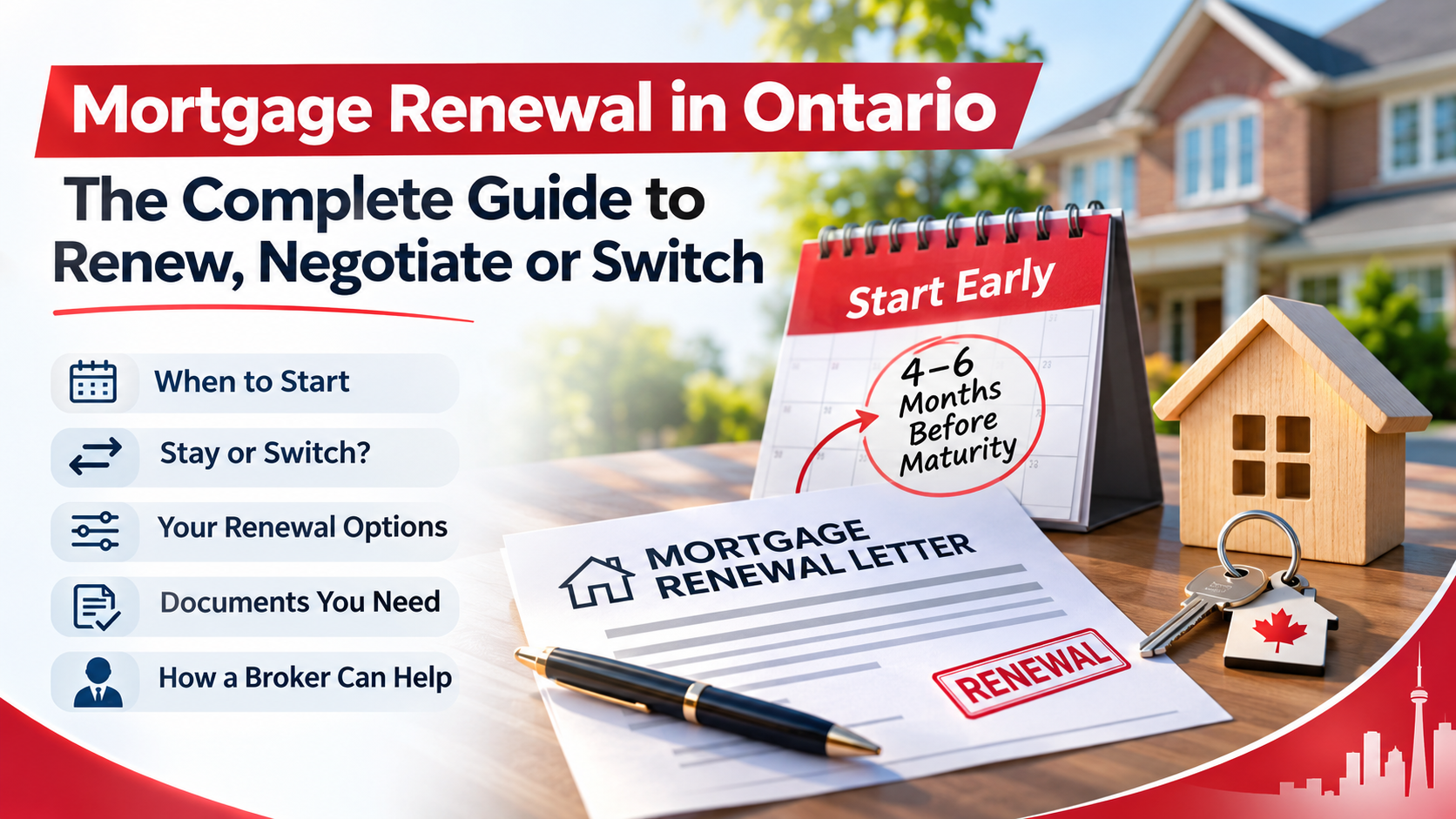
Start four to six months before your maturity date. Here’s why that window matters:
- Many lenders let you renew early without a penalty in the last few months of your
term. Ask yours for its exact window. - A new lender can usually hold a rate for a few months while you decide. If rates
drop before you close, you may get the lower one. - If your mortgage is with a federally regulated lender, like a bank, it only has to send
your renewal statement 21 days before the term ends (BNN Bloomberg, citing
FCAC). Three weeks is not enough time to shop properly.
A simple timeline
- 6 months out: find your maturity date, balance and remaining amortization on your
latest statement. - 4 months out: get competing quotes and a rate hold.
- 3 months out: ask your current lender to match or beat the best offer, in writing.
- 6–8 weeks out: decide and sign. Switching lenders takes paperwork, so leave room.
Can you do an early mortgage renewal in Ontario ?
Yes, but there’s a difference. Renewing in the last few months is usually free. Renewing a
year or two early is technically “breaking” your mortgage, and it often comes with a
penalty. That can still make sense if rates have dropped sharply, but get the penalty in
writing first and run the numbers.
Why the first renewal offer is rarely the best one ?
Lenders know most customers don’t shop, as the FCAC figures above show. Renewal offers
are often a bit higher than what the same lender gives new clients.
A small gap adds up. By our calculation, on a $450,000 balance, a rate that’s 0.5% lower
saves roughly $10,000 in interest over a five-year term. That’s for one phone call and
some paperwork.
Many Brampton homeowners are renewing now from the very low rates of 2020 and 2021.
For them, the payment jump can be large. Shopping the renewal doesn’t erase it, but it can
soften it.
Should I switch lenders at renewal in Ontario ?
It depends on three things.
- The total cost, not just the rate. Switching can involve a discharge fee, legal fees and an
appraisal. Many lenders cover some or all of these to win your business. Ask for a full
breakdown. - Whether you still qualify. This is where the rules changed in your favour. Since
November 21, 2024, if you switch an uninsured mortgage to another federally regulated
lender without increasing your loan or your amortization, the lender no longer has to
apply the stress test (OSFI). Insured mortgages already had this exemption (Department
of Finance Canada). The new lender will still review your application, but switching is
much easier than it used to be. - The fine print. Compare prepayment privileges, penalty calculations and whether the
mortgage is portable if you move. A slightly higher rate with fair penalties can be the better
deal if you might sell in the next few years.
When staying usually makes sense ?
- Your lender matches the best offer you found.
- You want to add a HELOC or borrow more, which reopens full qualification
anywhere. - Your income has dropped or become harder to prove (common for newly self-
employed borrowers and owner-operators).?
When switching usually makes sense ?
- The rate gap is meaningful after fees. We typically look for 0.25% or more.
- You want better prepayment options or a portable mortgage.
- Your current lender refuses to negotiate.
Your mortgage renewal options in Ontario
Renewal is a chance to rethink the whole mortgage, not just the rate:
- Fixed or variable. Fixed gives you a set payment for the term. Variable moves with
the lender’s prime rate. Neither is always better. - Term length. Shorter terms (2–3 years) give you a sooner chance to renegotiate.
Five years gives you longer certainty. - Payment frequency. Accelerated bi-weekly payments mean 26 half-payments a
year, which works out to one extra monthly payment a year and shortens your
amortization. - Lump sum. If you’ve saved some cash, renewal is the one time you can pay down
any amount with no penalty.
Renewing your mortgage with bad credit in Ontario
If your credit has taken a hit since you got your mortgage, staying with your current
lender is often the easier path. A straight renewal with the same lender usually doesn’t
involve full requalification.
Switching is harder, because the new lender will review your application, including your
credit. If your current lender won’t renew you at all, it must tell you at least 21 days before
the term ends if it is federally regulated (BNN Bloomberg, citing FCAC). In that case, an
alternative lender may be an option for one term while you rebuild. Our guide to bad credit
mortgages in Brampton explains how that works.
What documents to prepare ?
If you renew with your current lender, you may need little more than a signature. If you
switch, expect to provide:
- Your current mortgage statement and renewal offer
- Photo ID
- A job letter and recent pay stubs, or two years of tax returns if self-employed
- Your latest property tax bill
- Home insurance details
How a mortgage renewal broker in Brampton helps ?
A broker gets you competing offers from several lenders at once, usually at no cost to you
on a standard renewal because the lender pays the broker. We also do the comparison you
don’t have time for: penalties, fees and fine print, side by side.
If your mortgage matures in the next six months, [book a free renewal review] with
[Agent name] at [phone number]. Bring your renewal letter, and we’ll tell you in 15
minutes whether it’s worth shopping.
Frequently asked questions ?
How early can I renew my mortgage in Ontario?
Many lenders allow a penalty-free renewal in the last few months of your term. Ask your
lender for its exact window. Renewing much earlier usually means paying a penalty.
Do I have to pass the stress test to switch lenders at renewal?
Not for a straight switch to a federally regulated lender, as long as you keep the same loan
amount and amortization (OSFI). If you borrow more, the stress test applies.
What happens if I don’t sign my renewal?
Your lender may automatically renew you, often into a short term at a rate that isn’t
competitive. Don’t let the date pass without a decision.
Does it cost money to switch lenders at renewal?
There can be discharge, legal and appraisal fees. Many lenders cover some of these for
switch clients, so ask before you decide.
Where can I check current mortgage renewal rates in Ontario?
Rates change weekly. See our [current rates page] or call us for today’s numbers.
Sources
- Backgrounder: Minimum Qualifying Rate (MQR), Office of the Superintendent of
Financial Institutions, November 21, 2024 - Government announces boldest mortgage reforms in decades, Department of
Finance Canada, September 16, 2024 - Mortgage renewal deadlines and traps to know before you sign, BNN Bloomberg,
July 27, 2026 (cites Financial Consumer Agency of Canada rules and research)
The $10,000 savings example is a Done Mortgage calculation. Sources checked October 27, 2026
This article is general information, not financial advice. Lender policies, rates and fees vary.
Speak with a licensed mortgage agent about your situation.