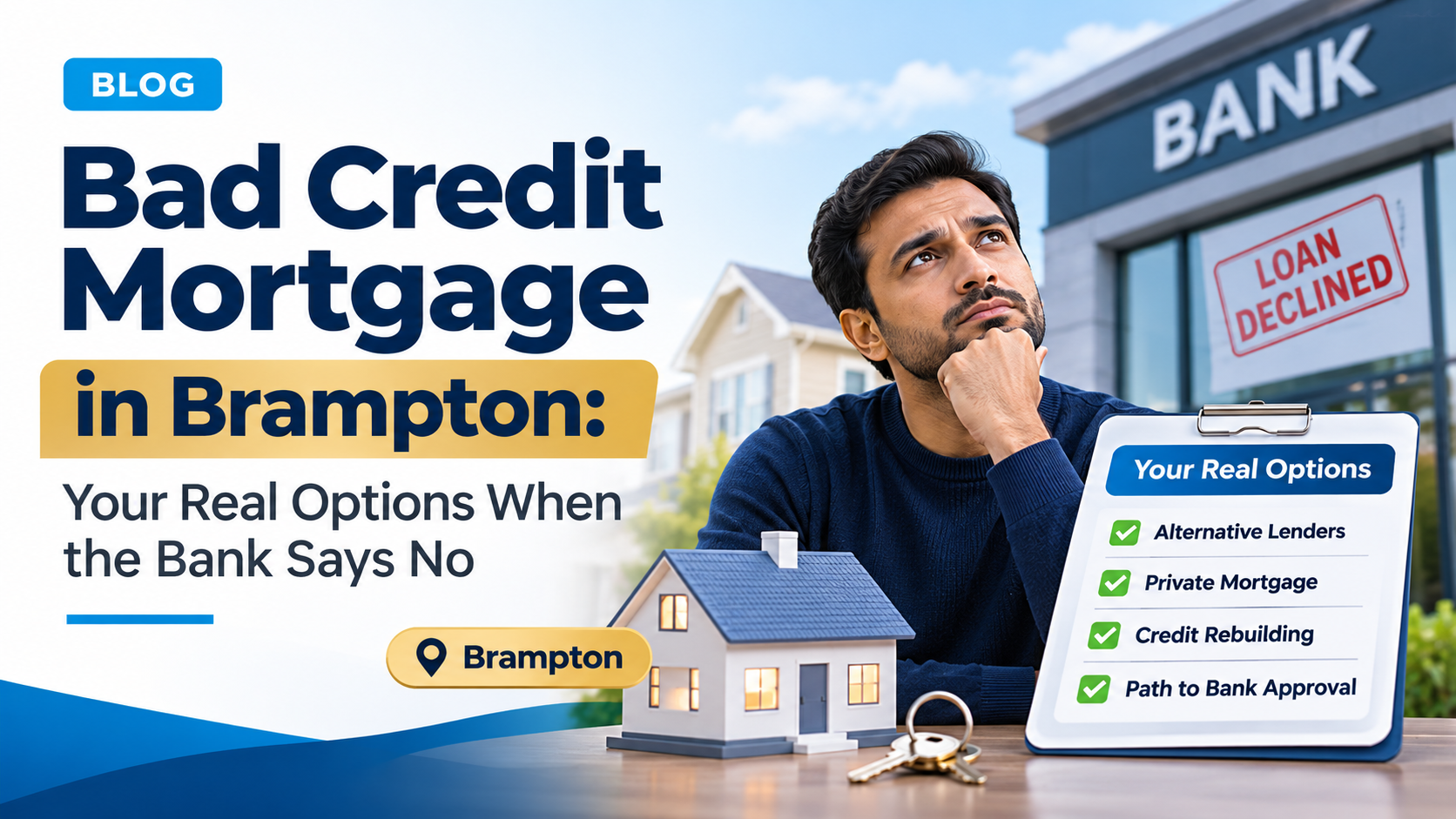
A bank decline feels final. It usually isn’t.
Banks are only one part of the mortgage market, and they’re the strictest part. If your bank turned you down because of missed payments, high card balances, a consumer proposal or a past bankruptcy, there are often other routes. This guide explains how a bad credit mortgage in Brampton works, what it really costs, and how to get back to bank rates as quickly as possible.
What is the minimum credit score for a mortgage in Ontario?
There’s no single number, because each type of lender sets its own bar. The one official benchmark: for a CMHC-insured mortgage (less than 20% down), at least one borrower must have a credit score of 600 or higher (CMHC).
Beyond that, here’s how the three types of lenders compare:
| Lender type | Credit score expectations | What to expect |
|---|---|---|
| Banks and credit unions (A lenders) | 600+ for insured mortgages; higher scores get the best rates | Lowest rates, strictest rules |
| Alternative lenders (B lenders) | Below bank minimums considered, case by case | Higher rate, larger down payment, lender fee |
| Private lenders | Credit matters less than home equity | Highest cost, short terms |
Your score is only the start. Lenders also look at why it’s low. A low score from one bad year two years ago reads very differently from the same score with missed payments last month.
What counts as “bad credit” to a lender?
- Late payments in the last one to two years, especially on a mortgage, car loan or credit card
- High credit use, such as cards near their limits
- Collections that are still unpaid
- A consumer proposal or bankruptcy, even if completed
- Thin credit, meaning too little history to judge. This is common for newcomers to Canada.
How a B lender mortgage works in Ontario
Alternative lenders, often called B lenders, lend to people who don’t fit bank rules. They look harder at your income, your down payment and the property, and less at your score.
What a B lender mortgage in Ontario usually looks like:
- Down payment: usually larger (20%) than a bank would ask for
- Rate: higher than a bank’s
- Lender fee: often charged on top, as a percentage of the mortgage
- Term: short, which is the point. It’s a bridge, not a destination.
Ask for every rate and fee in writing before you sign. Rates and fees vary widely between B lenders, so we’ll show you the exact numbers for your situation.
The goal of a B lender mortgage is to give you time to rebuild your credit, then move back to a bank at renewal.
When private mortgage lenders in Brampton make sense
Private lenders are individuals or investment groups. They lend mostly against your home’s equity, so credit and income matter much less.
That flexibility is expensive. Rates are much higher than bank or B lender rates, payments are often interest-only, and there are usually lender and broker fees. Terms are short, often one year.
A private mortgage can make sense to stop a power of sale, pay off tax arrears or consolidate high-interest debt for a short time. It only works if you have a clear exit plan: how you’ll refinance or sell before the term ends. If no one can explain your exit plan, don’t sign.
Getting a mortgage after bankruptcy or a consumer proposal in Ontario
After a bankruptcy: banks want to see that you’ve been discharged, that time has passed, and that you’ve rebuilt new credit and paid it on time. Some B lenders will consider you sooner, with a larger down payment.
After a consumer proposal: some B lenders will lend while your proposal is still being paid, or soon after it’s done. Banks generally want it completed, with time to rebuild after.
Waiting periods differ from lender to lender. A consumer proposal mortgage broker in Brampton can tell you which lenders accept your timeline before any credit check is run, which saves you from collecting extra inquiries.
An example of how this plays out
Consider a self-employed owner-operator in Brampton with a 590 credit score after a slow year. That’s below the 600 needed for an insured mortgage (CMHC), and his tax returns show low income after write-offs, so his bank declines him.
A B lender looks at his bank deposits instead and approves him for a short term with 20% down. Over that term he pays every bill on time and brings his card balances down. At renewal, his score has recovered, and he moves to a bank rate.
That’s the path we aim for with every bad credit client: in for a term, then out.
How to improve your credit score for a mortgage in Ontario
- Pull both credit reports, from Equifax and TransUnion. They’re free, and errors are common.
- Dispute anything wrong, such as a paid debt still showing as owing.
- Pay card balances down well below their limits. High balances relative to your limits pull your score down.
- Never miss another payment. Set up automatic minimum payments as a safety net.
- Keep old accounts open. Closing them shortens your history.
- Stop applying for new credit in the months before your mortgage.
What a bad credit mortgage broker in Brampton does differently
Every application you make on your own can add a hard inquiry. A broker reviews your situation first, then sends one application to the lender most likely to say yes.
We also do the part that matters most later: we give you a written plan for getting back to bank rates at renewal, and we check in before that date. See our mortgage renewal guide for how that step works.
Before you choose any broker, ask: Are you licensed with FSRA? Which lenders do you work with? What fees will I pay, and when? A good broker answers all three in writing.
Talk to [Agent name] at [phone number] for a [free, no-impact credit review].
Frequently asked questions
What is the minimum credit score for a mortgage in Ontario?
For an insured mortgage (under 20% down), at least one borrower needs a score of 600 or more (CMHC). Alternative and private lenders may go lower, usually with more money down.
What is a B lender mortgage?
It’s a mortgage from an alternative lender that serves borrowers who don’t meet bank rules. Rates are higher, terms are short, and the aim is to move back to a bank later.
How long after bankruptcy can I get a mortgage in Ontario?
It depends on the lender. Banks want time since discharge and rebuilt credit. Some alternative lenders will consider you sooner with a larger down payment.
Are bad credit home loans in Ontario more expensive?
Yes. You’ll usually pay a higher rate and a lender fee. The cost is worth it only if you have a plan to refinance to a lower rate later.
Will talking to a broker hurt my credit?
An initial conversation doesn’t. A full application usually involves one credit check, which a broker can use with the right lender instead of many.
Sources
- CMHC Newcomers: mortgage loan insurance eligibility, Canada Mortgage and Housing Corporation (minimum credit score of 600)
Lender practices described here (B lender and private lender terms, waiting periods after bankruptcy or a consumer proposal) vary by lender and are not set by any official rule. Sources checked October 27, 2026.
This article is general information, not financial advice. Approval, rates and fees vary by lender and borrower. Speak with a licensed mortgage agent about your situation.